Examining Microsoft's latest 'frontier' playbook
Whenever my feed serves up anything with the words "Frontier" and "AI" jammed together, my brain tunes out.
"Frontier" has become one of those meaningless tech buzzwords we can't escape. We have frontier models, OpenAI’s Frontier AI, Anthropic’s essays about pacing the frontier, and now Microsoft’s guide to becoming a Frontier Firm. It’s designed to evoke open horizons and a gold rush—though given the lawless, regulation-free chaos the AI industry is selling us right now, maybe this "Wild West" metaphor actually fits...
Anyway, jargon aside, I did read Microsoft's latest "Becoming a Frontier Firm" playbook. Once you look past the corporate marketing gobbledy-gook, there are a few sharp insights worth paying attention to.
Management layers...poof!
I worked at Microsoft back when 10 or more layers sat between me and the CEO—a time when landing a "skip-level" meeting with your boss’s boss’s boss was a big deal.
-shudder- I’m still a little traumatized from those corporate days, to be honest...
In the new playbook, Microsoft credits AI with making radically flatter organizations possible, cutting management layers down to about 5 across their software engineering org. Across the 220,000+ person company, manager spans of control doubled, with leaders overseeing 15 people instead of 7.
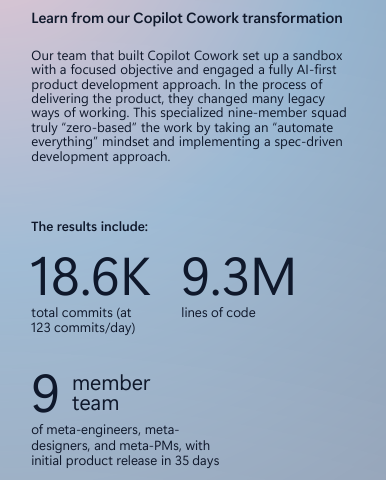
But this is more than just a "fire all the managers" story. Microsoft is sharing real-world speed gains, like a small 9-person team shipping Copilot Cowork in just 35 days. For anyone who remembers the years-long release cycles of legacy Microsoft, that speed is wild.
Instead of traditional managers who just report status, they’re shifting toward "player-coaches." I picture them like a soccer football team captain: leading the strategy, but right there on the pitch playing alongside everyone else.
The era of the pure, hands-off corporate manager is officially poof-ing away.
Rise of the generalist.
Having navigated a few different career personas myself, I’ve always considered myself a generalist. But in corporate land, being a generalist often came with that old stigma: "jack of all trades, master of none."
But the playbook and Brad Smith's related interview suggests that AI flips that story and gives generalists superpowers.
For decades, professions grew narrower and hyper-specialized because maintaining deep technical knowledge required total focus in one silo. Now that AI can handle complex execution tasks on demand, such as coding or analyzing data sets, value is shifting.
It’s no longer about being the narrow expert who executes one specific technical chore; it’s about being the broad thinker who can connect the dots, apply judgment, and run a project from start to finish.
Instead of hyper-specializing, people can expand horizontally and become truly "T-shaped". As a recovering T-shaped person myself, that shift to broader, end-to-end ownership speaks directly to me.
AI needs your "taste."
Everyone can tell when a piece is written by AI. It lacks personality, has a specific rhythm, and perhaps too many em dashes.
(And yes, I will die on the em dash hill and keep using them in my writing—ALT 0151 forever! If it seems like I'm an LLM, so be it).
What elevates average AI writing into something great is a writer's unique taste and judgement.
And, for organizations, feeding AI their unique taste and judgement can also be their competitive advantage.
Every company possesses tacit knowledge: an institutional memory, a unique customer philosophy, and an unspoken sense of what "good" actually looks like. But because base foundation models are trained on the public data, deploying them out-of-the-box risks "averaging away" your company's distinct point of view.
Microsoft’s suggested formula is codifying that tacit taste into private evals. These are concrete testable environments that teach AI how your organization operates. By safely connecting AI to your proprietary corpus of knowledge inside your security boundary, you fill in its blanks and ensure your enterprise intelligence compounds over time.
Push goals past efficiency.
One of my favorite sections of the playbook is about goal setting...or more accurately, the lack of ambition in how most companies set goals.
Teams can fall into the trap of deploying tools first and then only measuring bottom-up activity, like how many people are using Copilot, or if they're really ambitious, hours saved.
Microsoft challenges us to setting better goals, by saying:
"Efficiency is the floor. Experience, innovation, and growth are the ceiling."
For an AI project goal, starting with cost reduction or time savings as your floor is fine, but if you stop there, you miss the actual transformation.
To push past efficiency in goal setting, Microsoft suggests asking questions like:
What bigger opportunity are we missing?
Where can this improve the customer or employee experience?
How does this change our innovation path?
What new capability can we deliver, that was impossible before?
As one CEO puts it to Microsoft leadership:
I’m not implementing AI—I’m implementing my business strategy using AI.
Closing thoughts.
The main takeaway here is quite simple: AI alone isn't going to transform an organization overnight without some care and planning. Flattening teams, empowering generalists, codifying your organization's taste, and setting ambitious goals are some of the things that can turn technology into real impact.
As always, the tech is the easy part. Changing how we work is where the "frontier" is won.